What labels fit my identity?
Labels are a tricky thing. Many people who think they might not be "cisgender/heterosexual" try to find a new label to fit them, and struggle when one doesn't feel right.
Which Bucket is Mine?
Take this example - if you start questioning your gender identity, does that automatically make you trans? Maybe!
I've met many people who want to fit inside a neat box. They'd love to be able to understand themselves, and feel like taking an established label - complete with its own community - will make things easier. And I can understand that. It's a comfort to know that other people are like you; that what you're feeling is exactly the same as other people go through.
But in a lot of ways, it's harmful to jump to conclusions. Being transgender in our current society is difficult, for one. And for another, it's just one axis on a many-dimensional spectrum of personal identity.
I'm not trying to imply that you have to have everything figured out right from the start of your journey, but I do want to encourage you to take some time at some point along the way and think through all the different aspects of your identity.
Secret Buckets
There's a large portion of the population that believes there are two genders and one sexuality. You are a boy or a girl, and you must be attracted to the opposites. Everyone is cisgender, and heterosexual. Gender is a fixed thing that is decided by your parents or doctors, maybe even before you are born.
Even though many of us reject this view of the world, it still colors our perception.
Many of us don't fit into "hetero boy" or "hetero girl". But the thing is, humans love buckets. We love reducing things to simple categories that are easy to organize. It makes our brains happy to not have to think about things too much.
It can be comforting to think that there's another bucket that already exists that we fit right into. So we might jump to the conclusion that, since we don't fit into either of those two buckets, that some other label like 'transgender' (or non-binary, genderfluid, etc) is the secret third bucket we fit into.
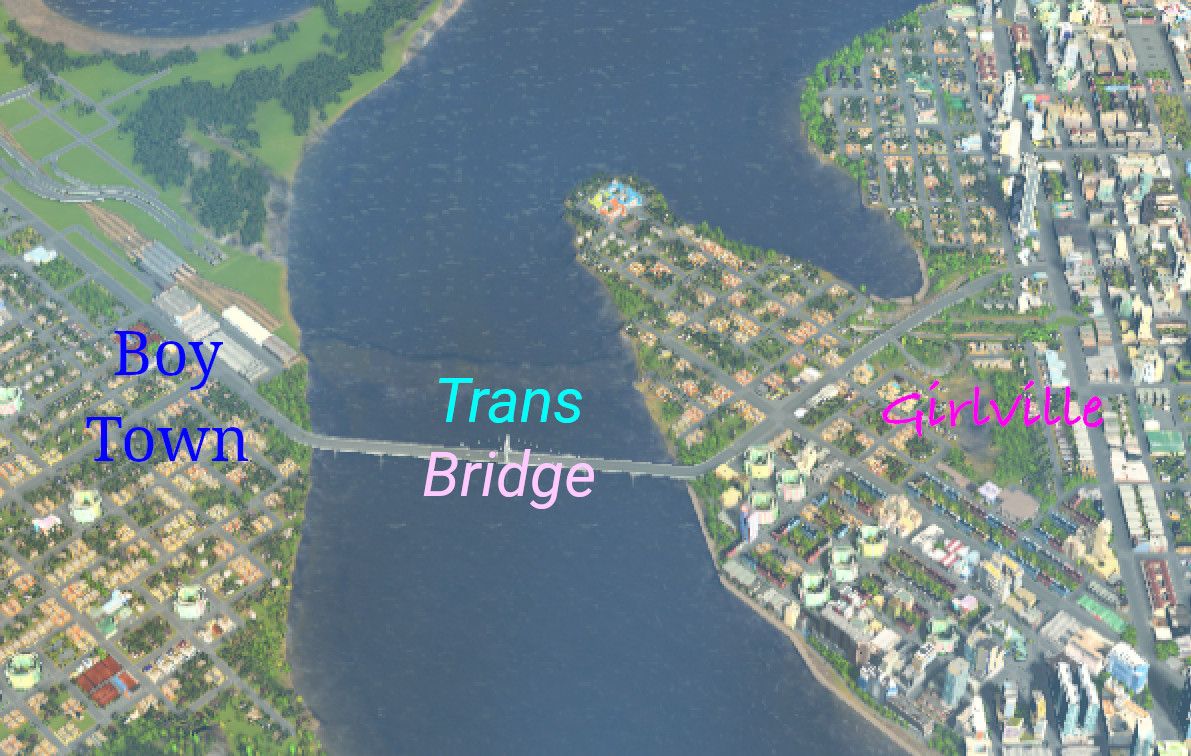
It might feel like you're taking the "Trans Bridge" from your birth gender to your desired gender.
Except... that's not the way it works. Gender and sexual identity are a spectrum. But 'spectrum' isn't really enough of a descriptor, either. Spectrum often evokes 'colors,' of something linear between point A and point B. This is more complex than that. It's a multidimensional matrix of near infinite possibilities.
There are big blobs in there that we've chosen to stick certain words to, but those don't cover the entire space by any stretch of the imagination.
Maybe you do fit into one of those labeled regions. Maybe not. Maybe it takes several labels to describe you, or perhaps you are beyond description. (That's pretty awesome, in my humble opinion...)
It might feel bad to be a gender explorer in "uncharted identity space." Maybe initially it feels lonely or confusing. Labels can become an anchor to keep you grounded - just don't let them weigh you down.
In the long term, think about labels as a shorthand to helping you explain yourself to others - or even to yourself! They're a common way to communicate or to set a starting point for people to understand you.
Realize the truth: there are no buckets
One of the early realizations I had after I accepted my trans-ness was that I could be anything I wanted to be. I broke the constraints of the 'bucket' that society wanted me to be in, and I wasn't just shuffling off to sit in another bucket. I could just be me.
Trying to be 'fem' was intimidating before I had this realization. There was so much to learn and to practice. What if I was bad at makeup, or hated shaving my legs? I needed to do these things as part of my new gender, or else. But that isn't true.
Instead, my new outlook is more akin to "unlocking the advanced sliders in character creation." The preset characters were the "old" labels. I didn't have to pick between "short haired, muscly boy" and "long haired, petite girl" anymore. I can make whatever choices suit me! I can change my mind whenever I want!
Alignment & Labels
Another way to look at this is that the label is a result of your choices and preferences, not the other way around.
When playing Dungeons & Dragons (or similar role playing games), we often talk about a character's alignment. Something like "Chaotic Good" or "Lawful Evil." You've probably heard of these (or seen memes...).
In D&D, there's a box on the character sheet for which alignment your character is. Often we fill this box in when we're building a new character. Then, as we play, we look at that alignment and try to use it to help us make decisions "in character." Would my character help someone with no expectation of reward? Would they turn on their allies if a better deal came along?
But the better (in my opinion) way to play is in reverse - your actions determine your alignment. Instead of saying "well, my character is going to do this thing because the box on this sheet says so," we think "my character would handle this situation this way, because of who they are."
Over time, patterns emerge, and it might fit into one of those established alignments. Or it might drift some. There's a lot of nuance to be considered. After all, even the most saintly of people might still condone breaking the law under certain circumstances.
The labels you use for yourself should operate the same way. Instead of trying to fit your whole person into a convenient set of words that describes you, figure out you first. Then, figure out what labels best fit that.
So what are you?
Really, that's for you to decide. I realize that might not be the answer you're looking for, but it's the best answer I have.
I'll leave you with some reminders as you try to figure out who you are:
- Nobody can really tell how you feel or who you are on the inside. Don't let other people pick your labels for you.
- Labels are descriptive, not prescriptive. Unlike getting a diagnosis for a disease, labels don't tell us more about ourselves, or tell us the "right way" to live.
- The labels we choose can be changed. Nothing's permanent!